

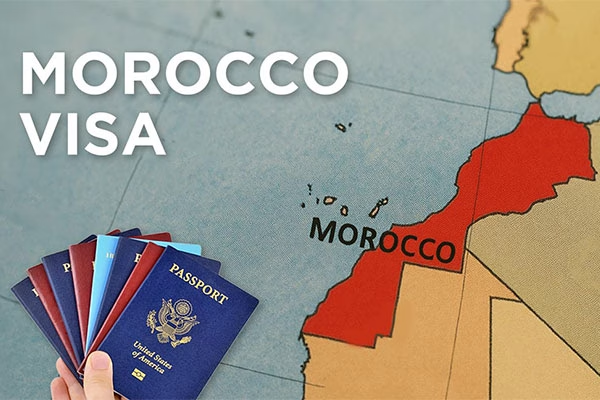

Most travelers from the UK, USA, Canada, Australia, Ireland, and EU countries do not need a visa to enter Morocco — you can stay up to 90 days on a valid passport. Your passport must be valid for at least 6 months beyond your departure date from Morocco. Entry is through standard border control and is fast for the majority of international visitors arriving at Marrakech airport.
Do You Need a Visa for Morocco?
Morocco operates one of the most straightforward entry systems in Africa. Citizens of over 60 countries can enter visa-free for stays of up to 90 days — covering the large majority of tourists arriving in Marrakech, Fes, Casablanca, and the Sahara each year.
The fundamental rule is simple: check that your nationality qualifies for visa-free entry, confirm your passport is valid for at least 6 months from your arrival date, and carry evidence of onward or return travel in case you are asked at the border.
For travelers from countries not covered by the visa-free arrangement, a tourist visa must be obtained from a Moroccan embassy or consulate before departure. Morocco does not offer visa on arrival for most nationalities.
Visa-Free Countries — Who Can Enter Morocco Without a Visa?
The nationalities below can enter Morocco for tourism without a visa, for stays of up to 90 days. This covers the most common traveler markets visiting Marrakech.
Americas
Argentina, Brazil, Canada, Chile, Colombia, Mexico, Peru, United States of America, Venezuela
Europe
All EU member states, Albania, Andorra, Bosnia and Herzegovina, Iceland, Liechtenstein, Monaco, Montenegro, North Macedonia, Norway, San Marino, Serbia, Switzerland, Turkey, United Kingdom
Oceania
Australia, New Zealand
Asia & Middle East
Bahrain, Indonesia, Japan, Kuwait, Oman, Philippines, Qatar, Saudi Arabia, South Korea, United Arab Emirates
Africa
Algeria, Angola, Benin, Burkina Faso, Cameroon, Cape Verde, Central African Republic, Chad, Comoros, Congo, Côte d’Ivoire, Djibouti, Egypt, Equatorial Guinea, Eritrea, Ethiopia, Gabon, Gambia, Ghana, Guinea, Guinea-Bissau, Kenya, Libya, Madagascar, Mali, Mauritania, Mauritius, Mozambique, Niger, Nigeria, Rwanda, Senegal, Sierra Leone, Somalia, South Africa, Sudan, Tanzania, Togo, Tunisia, Uganda, Zimbabwe
Important: Entry rules can change without notice. This guide reflects conditions as of mid-2026. Always verify current requirements with the Moroccan embassy in your country or your government’s official foreign travel advisory before booking.
Countries That Require a Visa for Morocco
If your nationality is not on the visa-free list, a Moroccan tourist visa must be obtained before travel — from the Moroccan Embassy or Consulate in your country of residence.
Documents typically required:
- Valid passport with at least 6 months validity beyond your departure date from Morocco
- Completed visa application form (obtained from the embassy)
- Two recent passport-size photographs
- Confirmed hotel or riad booking showing your accommodation address
- Return or onward flight ticket
- Proof of sufficient funds for the duration of your stay
- Travel insurance (some consulates require this)
Processing time: Typically 5–15 working days, though this varies by country and season. Apply well in advance — do not leave this until the week before travel.
Visa fee: Varies by nationality and consulate. Check directly with your nearest Moroccan diplomatic mission for the current fee.
We recommend verifying requirements with your country’s Moroccan embassy at the time of booking, as policies can be updated.
The 6-Month Passport Validity Rule
Your passport must be valid for at least 6 months beyond your planned departure date from Morocco.
This is the single most commonly missed entry requirement. Airlines will typically refuse boarding if your passport does not meet this threshold — even if it is technically not yet expired. Moroccan border control will refuse entry for the same reason.
Practical example: If you fly to Marrakech and plan to leave on 20 September 2026, your passport must remain valid until at least 20 March 2027.
Check your passport expiry date before you book flights or accommodation. Passport renewal can take several weeks in peak periods, particularly in spring and early summer when demand is highest.
What Happens at Moroccan Border Control on Arrival
Regardless of nationality, all travelers pass through Moroccan border control on arrival. Here is what to expect and what to have accessible.
What border officers may check:
- Valid passport
- Return or onward flight confirmation (on your phone or printed)
- Accommodation details — your hotel name or riad address in Marrakech
- Proof of funds if asked (a bank card is generally sufficient)
The arrival process:
Your passport is scanned and stamped. You receive an entry stamp valid for up to 90 days. For visa-free travelers arriving at Marrakech Menara Airport, the process is typically quick — queues at passport control move steadily, particularly for flights from Europe.
Morocco no longer requires travelers to complete a physical entry card on arrival. The process is handled digitally by border officers.
Arriving at Marrakech Menara Airport (RAK)
Most international visitors to Marrakech arrive at Marrakech Menara International Airport (RAK), located 6 km from the city centre and approximately 15–25 minutes by private transfer from the medina.
The arrival sequence at RAK:
- Disembark and follow signs to Passport Control
- Join the international arrivals queue — it moves steadily
- Present your passport to the border officer
- Proceed to baggage reclaim
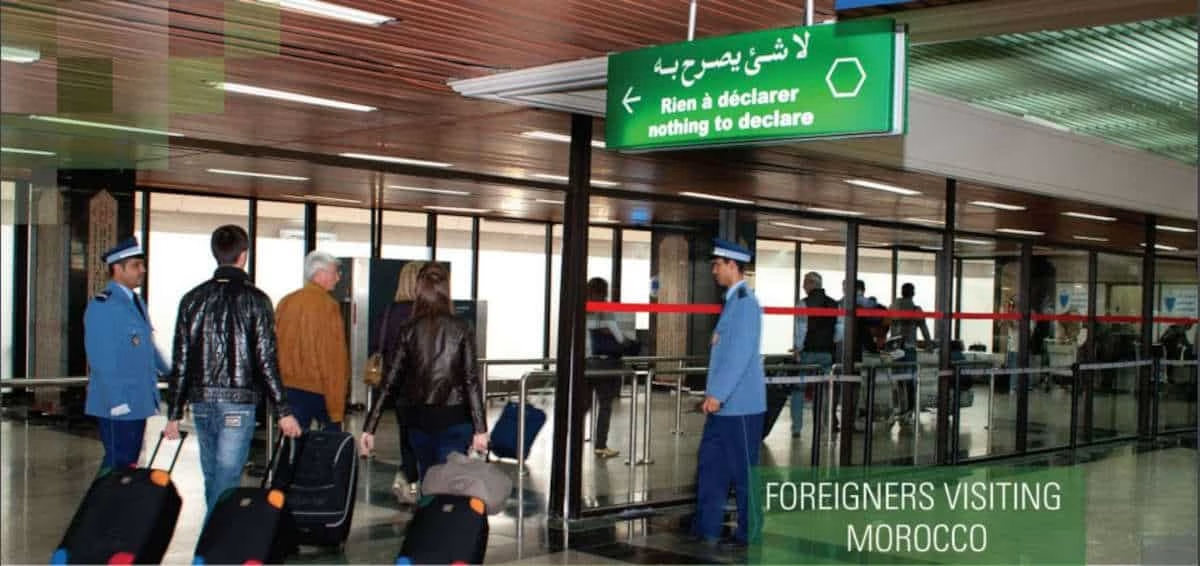
- Exit through the green customs channel (nothing to declare) or red channel if applicable
- Your transfer driver, taxi, or arranged transport is in the arrivals hall
Getting from the airport to your accommodation:
- Private transfer: 15–25 minutes, from 150 MAD for an Economy Sedan — the most convenient option, particularly with luggage. Your driver meets you in arrivals with a name board. Book your private Marrakech airport transfer before you land.
- Official petit taxi: 100–150 MAD day rate — available at the taxi rank outside arrivals. Agree the fare before departure or insist on the meter.
- Bus No. 19: 30 MAD — runs to Djemaa el-Fna but takes 30–50 minutes and is not well suited to luggage.
If you travel with Atlas Wings Group, your driver monitors your flight in real time and waits up to 60 minutes if delayed — at no extra charge.
The 90-Day Stay Rule
Visa-free visitors can remain in Morocco for a maximum of 90 days within any 180-day rolling period.
Key points to understand:
- The 90-day allowance does not reset annually — it is a rolling 180-day window
- Exiting and immediately re-entering Morocco does not reset the count — border officers track cumulative stays
- Overstaying requires engaging with Moroccan immigration authorities (Direction Générale de la Sûreté Nationale) and can result in fines or a ban on re-entry
- Extensions before the 90 days expire must be applied for in person at the immigration authority
For the vast majority of visitors — whether coming for a long weekend, a week, or an extended month-long trip across Morocco — the 90-day allowance is more than adequate.
Traveling to Morocco from the UK
UK passport holders enter Morocco visa-free for up to 90 days. This arrangement has not changed and is unaffected by Brexit. UK travelers do not need ETIAS (see below) and there is no pre-travel authorization required.
Your UK passport must be valid for at least 6 months beyond your departure date from Morocco. This is particularly important given current UK passport renewal waiting times — check your expiry date early and renew with adequate lead time if needed.
Does Morocco Require ETIAS?
No. ETIAS (the EU Electronic Travel Information and Authorisation System) applies to travel into the Schengen Area. It is an EU border system and has no relevance to Morocco.
Morocco is an independent country with its own entry policy. There is no ETIAS requirement, no ETA (Electronic Travel Authorization), and no online pre-registration required to visit Morocco from any visa-free country.
Traveling to Morocco from the USA, Canada, and Australia
USA: US passport holders enter visa-free for up to 90 days. No pre-approval or authorization needed.
Canada: Canadian passport holders enter visa-free for up to 90 days.
Australia: Australian passport holders enter visa-free for up to 90 days.
Standard requirements apply for all three nationalities: passport valid for 6+ months beyond departure, onward or return ticket, and accommodation details available if asked.
Currency — Dirhams and Money on Arrival
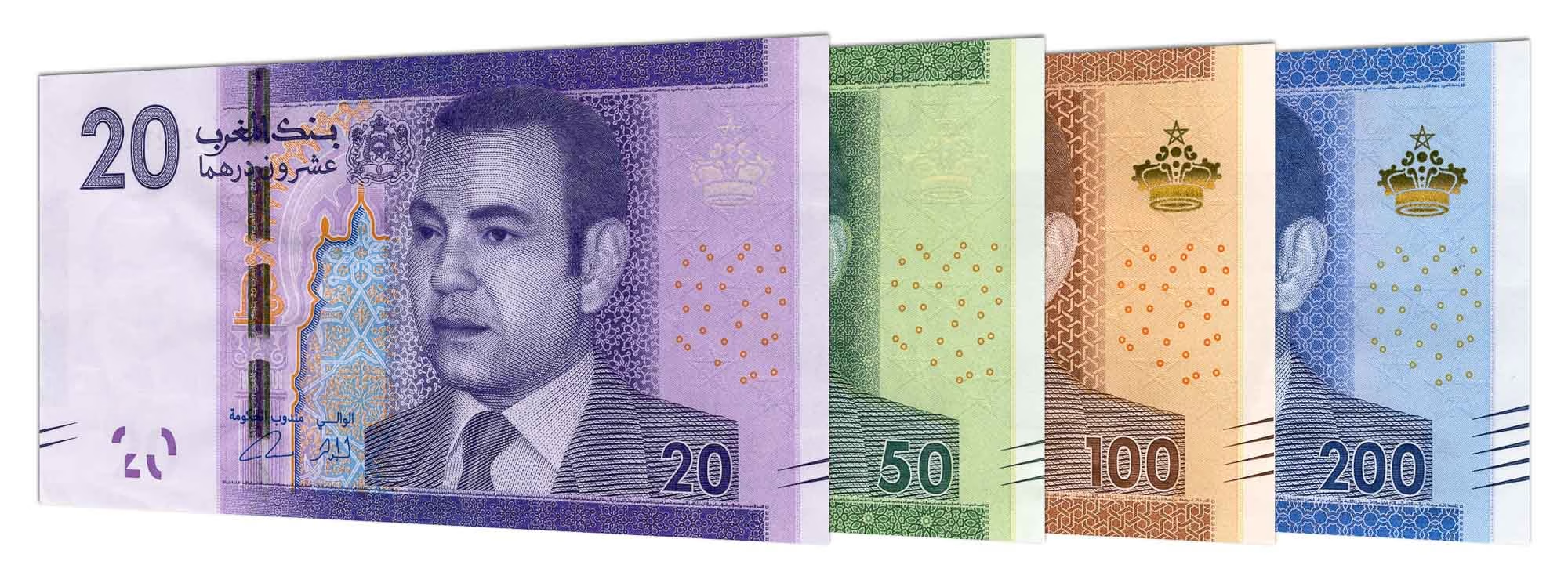
Morocco’s currency is the Moroccan Dirham (MAD). A few rules that catch first-time visitors off guard:
- Dirhams are a restricted currency — they cannot be freely imported or exported in significant quantities and are not widely available outside Morocco
- Bring foreign currency — GBP, EUR, and USD are all easily exchanged on arrival
- Currency exchange is available at RAK airport on arrival, at banks throughout Marrakech, and at licensed exchange offices in the medina (avoid unlicensed street exchangers)
- Airport exchange rates in Marrakech are reasonable — there is no particular advantage to waiting
- Credit and debit cards (Visa, Mastercard) are accepted at hotels, riads, and most restaurants; less reliably in the souks and traditional markets
- ATMs are widely available in Marrakech city centre and near all major tourist areas
Travel Insurance and Health Requirements
Morocco does not require proof of travel insurance as a condition of entry. However, it is strongly recommended for all visitors.
Private medical care in Marrakech is available and generally competent for most situations, but costs can be significant without insurance. Travel insurance covering medical emergencies, evacuation, and trip cancellation is standard practice for responsible travel to Morocco.
Vaccinations: Morocco has no mandatory vaccination requirements for entry from most countries. Ensure routine vaccinations are current. Check your government’s travel health advisory for any recommendations specific to your nationality or travel region.
Practical Checklist Before You Travel to Morocco
Run through these before booking and before departing:
- Check your passport expiry date — valid for 6 months beyond your Morocco departure date
- Confirm your nationality qualifies for visa-free entry — or start the visa application process early
- Book your accommodation in advance — having a confirmed riad or hotel address ready for border control is good practice and makes arrivals smoother
- Save your return or onward ticket — on your phone or printed, ready to show if asked
- Arrange your airport transfer before you land — arriving in Marrakech without pre-arranged transport adds unnecessary friction, especially after a long flight
- Bring GBP, EUR, or USD — exchange to dirhams on arrival or in the city
- Get a Moroccan SIM card on arrival — Maroc Telecom and Orange Morocco both sell tourist SIMs at the airport; data is cheap and useful for navigation in the medina
- Dress modestly from the moment you arrive — Morocco is a conservative Muslim country; respectful dress is appreciated, particularly when moving through the medina
Frequently Asked Questions — Morocco Visa & Entry Requirements
Do I need a visa to visit Morocco?
Citizens of the UK, USA, Canada, Australia, EU countries, and many others enter Morocco visa-free for up to 90 days. If your nationality is not on the visa-free list, apply for a tourist visa at a Moroccan embassy before travel. There is no visa on arrival for most nationalities.
How long can I stay in Morocco without a visa?
Up to 90 days within any 180-day rolling period. Extensions beyond this must be applied for through Moroccan immigration authorities before your permitted stay expires.
Does my passport need to be valid for 6 months to enter Morocco?
Yes. Your passport must remain valid for at least 6 months beyond your planned departure date from Morocco. Airlines will refuse boarding, and border control will refuse entry, if this condition is not met.
Is there a visa on arrival in Morocco?
No. Morocco does not offer visa on arrival for most nationalities. If a visa is required, it must be obtained from a Moroccan embassy or consulate before departure.
Can I extend my stay in Morocco beyond 90 days?
Yes, but it requires a formal application to the Direction Générale de la Sûreté Nationale before the 90-day limit expires. Simply exiting and re-entering is not a reliable or permitted workaround.
Do I need travel insurance to enter Morocco?
Travel insurance is not a legal entry requirement. It is strongly recommended — medical costs in private facilities can be significant without cover, and trip cancellation insurance protects your investment.
What currency should I bring to Morocco?
Bring GBP, EUR, or USD and exchange to Moroccan Dirhams (MAD) on arrival at the airport or in the city. Dirhams cannot be imported in significant quantities and are not available outside Morocco.
What do I need to show at Moroccan border control on arrival?
Your valid passport, your return or onward travel confirmation, and your accommodation address in Morocco. Border control at Marrakech airport for visa-free travelers is typically efficient and straightforward.
Does Morocco require ETIAS?
No. ETIAS applies to EU Schengen zone travel and has no relevance to Morocco. There is no equivalent pre-travel authorization required to visit Morocco.
Can I work in Morocco on visa-free entry?
No. Visa-free entry and tourist visas permit tourism only. Working in Morocco requires a separate residency and work permit.
Is Morocco safe for tourists?
Morocco is generally safe for international tourists. Marrakech has a well-established tourist infrastructure and authorities take visitor safety seriously. Solo travelers — including solo women — visit regularly without incident when following standard travel awareness.
What is the best way to get from Marrakech airport to my riad or hotel?
A pre-booked private transfer is the smoothest option — your driver meets you in arrivals with a name board, assists with luggage, and drops you at your riad’s nearest medina gate. Prices start from 150 MAD for an Economy Sedan. Book your Marrakech airport transfer here.
0 Comment